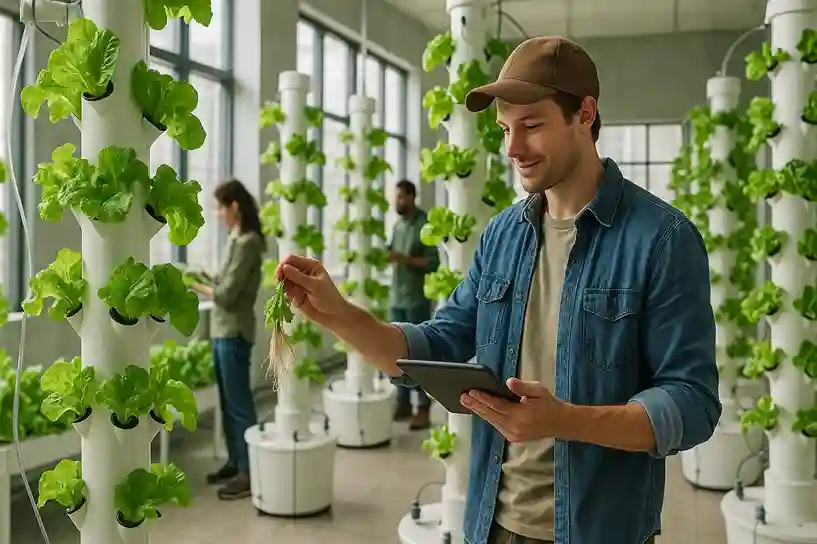
The aeroponic tower is transforming how farmers grow food, pushing agriculture into a cleaner, smarter, and more efficient era. Instead of using soil, this system suspends plant roots in air and nourishes them with a fine mist of nutrient-rich water. That means no messy fields, no wasted water, and no dependency on fertile ground. Each tower stacks layers of green growth upward, maximizing every inch of available space.
For modern farmers, this is a breakthrough — one that saves up to 95% of water and yields crops faster than traditional methods. Aeroponics eliminates soil-borne pests, reduces labor, and enables year-round cultivation in any climate. The result is a sustainable model that blends technology with nature’s simplicity. As global food demand rises and land becomes scarce, this innovation offers real hope for the future of agriculture. Let’s explore why the aeroponic tower might redefine farming forever.
What Makes the Aeroponic Tower So Revolutionary
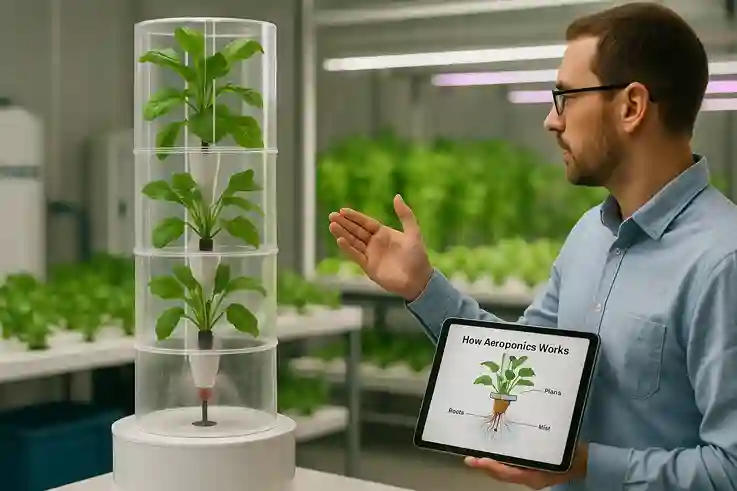
What makes the aeroponic tower so revolutionary is how it redefines growing from the ground up. In this system, plant roots hang freely in open air and absorb oxygen directly. A fine mist of nutrient solution sprays at regular intervals, feeding the roots efficiently. There’s no soil to block growth or carry disease. Every drop of water circulates back into the system, cutting waste close to zero.
Compared to traditional soil farming, the gains in efficiency are dramatic. Crops grow faster, use less than 10% of the water, and need no herbicides or pesticides. Because nutrients reach the roots instantly, plants absorb only what they require. That direct control removes inconsistencies from poor soil or harsh weather.
The modular, vertical design adds even more appeal. Each tower stacks plants upward, saving valuable space. A single tower supports dozens of crops in less than a square yard. Urban growers can install these systems on rooftops, balconies, or indoor farms lit by LEDs. This flexibility brings fresh produce closer to consumers and trims transport emissions.
Farmers also benefit from automation. Sensors monitor humidity, temperature, and nutrient flow in real time. Data-driven adjustments keep growth steady and predictable. Each decision improves yield and quality while reducing guesswork.
The aeroponic tower delivers control, consistency, and sustainability—all at once. Yet, the real power of the aeroponic tower lies in its precision.
“The aeroponic tower doesn’t just grow plants — it grows possibilities, proving that the future of farming can rise without touching the soil.”
Inside the Science: How Aeroponic Tower Feed Plants in Mid-Air
The aeroponic tower thrives on precision. Every stage of growth depends on accurate timing, balanced nutrients, and constant airflow. Instead of soil, plants rely on an intelligent misting system that delivers nourishment directly to exposed roots. This process allows plants to grow faster, stronger, and healthier than in any other medium.
Nutrient Delivery and Mist Cycles
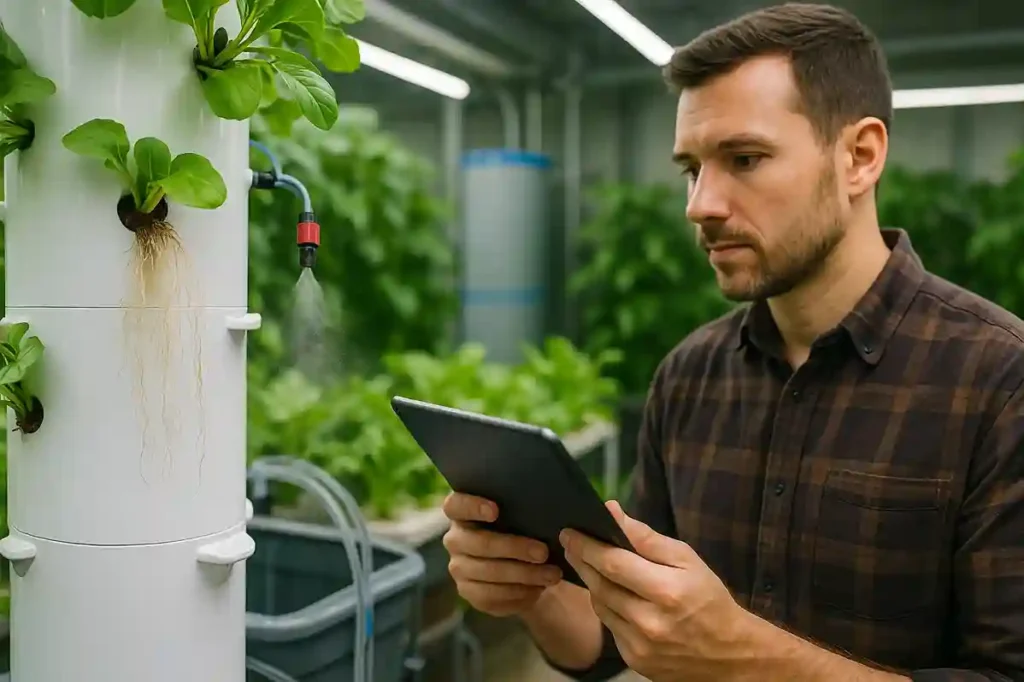
In an aeroponic tower, nutrient delivery happens through fine misting nozzles positioned near each plant’s root zone. These nozzles release a vapor-like spray of water mixed with essential minerals—nitrogen, potassium, calcium, and trace elements. Misting occurs in timed cycles, usually every few minutes, ensuring the roots never dry out or drown.
This rhythmic misting keeps moisture and oxygen levels perfectly balanced. Because nutrients reach the roots instantly, the plants expend less energy searching for them. That efficiency allows for faster growth, greater yield density, and reduced waste. The closed-loop system recycles unused solution, so farmers save water and maintain consistent nutrient levels.
Oxygen: The Invisible Growth Accelerator
Roots exposed to open air absorb oxygen freely. In soil-based farming, compacted earth often limits airflow, slowing root metabolism. In contrast, aeroponic roots breathe continuously. The combination of oxygen and mist enables roots to perform more photosynthesis-supporting processes, which accelerates growth cycles by up to 50%.
NASA’s controlled-environment studies confirmed this effect. Researchers discovered that plants grown with aeroponic methods in microgravity conditions developed thicker root structures and used 98% less water than traditional methods. That same principle now powers vertical farms on Earth, where oxygen-rich environments drive remarkable crop efficiency.
Balancing pH and Smart Nutrient Control
Every plant species has an ideal pH range for nutrient absorption. The aeroponic tower maintains this balance through automated sensors. These smart systems continuously monitor pH, temperature, and electrical conductivity in the nutrient solution. When readings drift out of range, small adjustments restore optimal levels within seconds.
Automation ensures uniform nutrition across every tower level. Farmers no longer rely on guesswork or manual sampling. Real-time data allows immediate correction, preventing nutrient lockout or overfeeding—two common issues in soil farming. The system learns and adapts, turning farming into a precise science rather than a series of unpredictable outcomes.
Each technological element—oxygen exposure, mist timing, and pH control—works together like clockwork. The result is a balanced ecosystem that maximizes growth speed and resource use. That efficiency soon translates into incredible yields.
Sky-High Yields and Sustainability Gains
The aeroponic tower is changing what farming means in the modern world. Its power lies not only in how it grows plants but in how it maximizes every resource available. By combining advanced nutrient delivery with minimal environmental impact, this system proves that abundance and sustainability can exist side by side.
Unmatched Yield Efficiency
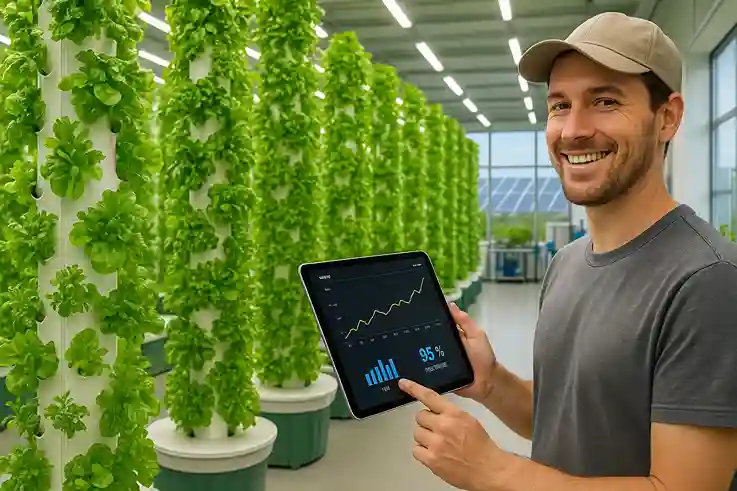
When compared to both soil and hydroponic systems, the aeroponic tower consistently outperforms. Crops grown aeroponically show 25% to 60% higher yields than those from hydroponic setups and nearly three times more than soil-based farming. Plants such as lettuce, kale, basil, and strawberries develop faster because they receive oxygen and nutrients directly through fine mist sprays.
In hydroponics, roots stay submerged in water, which limits oxygen intake. Aeroponics solves this by allowing roots to “breathe,” which accelerates cell division and nutrient absorption. As a result, growth cycles shorten by nearly one-third, enabling farmers to harvest more frequently without expanding land use.
This efficiency doesn’t just improve output—it also boosts quality. Produce grown in aeroponic towers often shows higher nutrient density, crisper texture, and better shelf life due to consistent nutrient balance.
Sustainability at Every Level
The environmental footprint of an aeroponic tower is incredibly small. It uses up to 95% less water than soil farming, thanks to a closed-loop system that captures and recycles every droplet. No water runs off, no fertilizer seeps into groundwater, and no soil erosion occurs.
Because the environment is sealed and carefully managed, zero pesticides are required. The system blocks pests naturally by limiting exposure and maintaining optimal humidity and airflow. This results in cleaner crops and safer food, completely free from chemical residues.
Aeroponic towers also demand less land—vertical stacking allows dozens of plants to thrive in a footprint smaller than a single square yard. This design opens new opportunities for cities and urban farms to grow food locally, reducing the distance food travels from farm to plate.
Energy and Carbon Balance
While aeroponics relies on pumps, lights, and sensors, the overall carbon footprint remains lower than traditional farming. Energy-efficient pumps and LED lighting now consume far less power than older systems. When powered by solar or wind energy, the aeroponic tower can reduce carbon emissions by up to 40% compared to soil cultivation.
Moreover, eliminating the need for tractors, irrigation canals, and chemical inputs cuts fuel use dramatically. Farmers save both energy and money while producing more food per square foot than ever before.
The aeroponic tower represents more than a technological upgrade—it’s a symbol of resilience. As water scarcity and land degradation challenge global food supply, aeroponic systems provide a sustainable path forward. They empower farmers to grow anywhere, anytime, without exhausting the planet’s resources.
It’s not just about growth — it’s about resilience.
The Aeroponic Tower and Urban Farming Revolution
The aeroponic tower has become a game-changer for city agriculture. With populations rising and green space shrinking, urban farmers now rely on vertical systems to produce fresh, chemical-free food right where people live. This innovation turns tight corners, rooftops, and walls into productive ecosystems that grow more while using less.

Urban Spaces Turned Green
Modern cities face a common problem—too little land for traditional farming. The aeroponic tower solves that elegantly. Its vertical design makes it ideal for rooftops, balconies, and even indoor corners lit with LEDs. Shipping-container farms now appear in parking lots, apartment complexes, and schools, using aeroponics to grow herbs, greens, and fruits without soil.
These systems thrive where traditional gardens can’t. A rooftop tower can grow hundreds of plants with no mess or runoff. Small-space growers love how easy it is to manage nutrient levels and water use. Everything stays automated, efficient, and sustainable.
Aeroponic farming also reduces urban heat, improves air quality, and reconnects city dwellers with nature. In essence, every tower becomes a micro farm—and a breath of green in the gray.
A Chicago Farmer’s Story
In Chicago’s South Loop, Lena Morales, a 27-year-old entrepreneur, turned her rooftop into a thriving micro-farm. Her journey began with one aeroponic tower and a simple goal: to grow her own organic greens affordably.
Within weeks, her tower yielded crisp lettuce, basil, and cherry tomatoes—all using 95% less water than a garden bed. The system’s automation freed Lena from constant upkeep; the misting nozzles handled hydration and nutrients perfectly. Encouraged by her results, she expanded to four towers, supplying produce to local cafés and a weekend market.
Today, Lena’s urban farm provides hundreds of fresh plants monthly. Her model inspired neighbors and nearby schools to explore aeroponics. What started as a hobby evolved into a community movement rooted in sustainability and innovation.
A Movement Spreading Across Cities
Urban farmers across the U.S. are following Lena’s lead. From Los Angeles warehouses to New York rooftops, aeroponic towers are sprouting everywhere. They supply restaurants, hospitals, and households with fresh produce while reducing transportation emissions and packaging waste.
These farms redefine food accessibility, making local produce available even in dense neighborhoods with limited land. They demonstrate how smart design and sustainable technology can empower communities to feed themselves efficiently. But rural farmers aren’t left out of this movement either.
Rural Integration: Smart Aeroponic Tower on Traditional Land
The aeroponic tower isn’t just for cities—it’s finding its place in the countryside, too. Farmers across rural America are discovering how this clean, efficient system complements their existing soil-based operations. Rather than replacing traditional crops, aeroponics adds a new layer of productivity and stability to the farming ecosystem.
Blending Innovation with Heritage
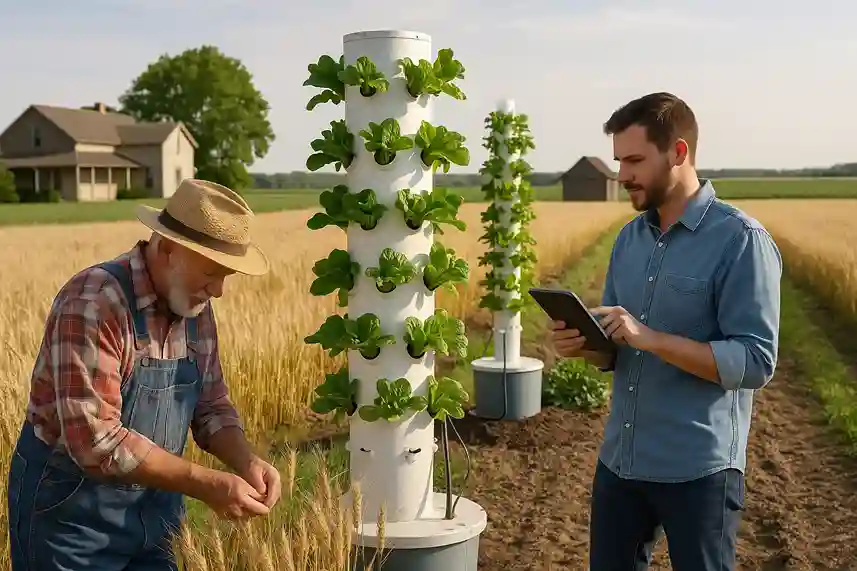
For generations, rural farmers have relied on soil and weather cycles to guide their harvests. But modern challenges—droughts, soil degradation, and unpredictable seasons—demand adaptable solutions. Aeroponic systems offer that flexibility. By integrating towers alongside open fields, farmers can produce high-value crops like lettuce, basil, or spinach all year, regardless of weather conditions.
This approach balances tradition with innovation. While corn, wheat, or soy still grow in fields, aeroponic towers deliver fast, consistent harvests of perishable greens and herbs. These crops can sell locally, diversifying income and improving cash flow between major harvests. For family farms, it means less risk and more resilience.
Energy Efficiency Through Renewables
Rural areas already harness sunlight and wind—two resources that pair perfectly with aeroponics. Many farmers now power their aeroponic towers using solar panels or small wind turbines, creating fully self-sustaining systems. These renewable energy setups reduce long-term costs and insulate farmers from fluctuating power prices.
With battery storage and smart controllers, energy can be stored for nighttime misting or nutrient pumping. The result is a sustainable cycle where the environment fuels production, and production supports the environment. Every tower becomes a small node in a clean-energy farming network.
Co-Farming for Maximum Output
One of the most exciting aspects of rural aeroponics is co-farming—combining traditional soil crops with vertical systems. Imagine rows of wheat waving in the breeze beside tall aeroponic towers growing lettuce, herbs, or strawberries. The two methods don’t compete; they complement each other.
While grain or fruit trees take months to mature, aeroponic crops grow in cycles as short as four weeks. Farmers can harvest greens multiple times between major field harvests, maintaining steady income and improving land productivity without expanding acreage.
Co-farming also reduces resource strain. The nutrient runoff from soil fields can be captured and filtered for reuse in aeroponic systems, closing the sustainability loop.
Rural integration shows that innovation doesn’t erase tradition—it strengthens it. The aeroponic tower gives rural communities the tools to adapt, diversify, and thrive in a changing agricultural landscape. Technology and tradition now grow side by side.
Overcoming Challenges: Cost, Maintenance, and Skill Gaps
Overcoming Challenges: Cost, Maintenance, and Skill Gaps
The aeroponic tower promises efficiency and sustainability, but like any advanced technology, it comes with hurdles. Farmers—both urban and rural—often face three major challenges: the high initial setup cost, technical learning curves, and maintenance demands. Yet these obstacles aren’t barriers—they’re stepping stones toward smarter, more profitable farming.
Tackling the Cost of Innovation
The biggest concern for most growers is the upfront investment. Aeroponic towers, along with sensors, misting systems, and control units, can cost significantly more than soil-based farming tools. However, this expense should be viewed through a long-term lens. Once installed, these systems dramatically reduce input costs—using less water, fewer fertilizers, and no pesticides.
Many early adopters report full cost recovery within two to four years, depending on scale and crop selection. High-value greens, herbs, and specialty produce bring quick returns, while energy savings add steady benefits over time. Moreover, government and private funding options are growing. Federal and state agricultural grants now support sustainable and controlled-environment farming projects. Some cooperatives even offer shared infrastructure programs, allowing small farmers to use aeroponic systems collectively, cutting costs while sharing output.
Bridging the Knowledge Gap
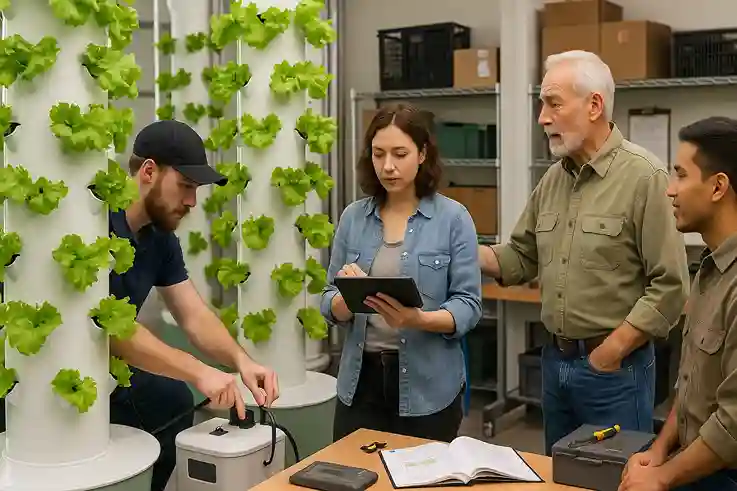
Operating an aeroponic tower requires understanding sensors, pH control, and automated nutrient cycles. For traditional farmers, this can feel unfamiliar at first. Fortunately, the learning curve is shrinking thanks to widespread training initiatives. Agricultural universities, extension services, and non-profit groups now run workshops and online certification programs for aeroponic system management.
Some manufacturers also provide in-person training, remote monitoring assistance, and maintenance support. Community farming cooperatives and local schools often host demonstration projects, giving farmers hands-on experience before full adoption. Once familiar with the system, most farmers find it far simpler than managing pests, irrigation schedules, and soil amendments in traditional farming.
Scalability and Sustainable Growt
Aeroponic systems scale smoothly. Farmers can start with a single tower and expand modularly, adding units as production increases. Maintenance is straightforward: cleaning nozzles, checking nutrient reservoirs, and monitoring sensor readings. Modern systems even alert farmers via mobile apps if issues arise.
While the initial learning phase requires time and patience, the long-term payoff is stability. Higher yields, lower water bills, and dependable year-round output soon outweigh the costs of setup and training. Once you master the system, the rewards follow fast.
The Future Outlook: AI, Automation, and Smart Nutrition
The aeroponic tower stands at the edge of a technological leap. What began as an efficient, soil-free growing method is now evolving into a fully intelligent ecosystem powered by artificial intelligence, automation, and data-driven precision. The next generation of towers won’t just grow plants—they’ll think about how to grow them better.
AI and IoT: The Brains Behind the Growth
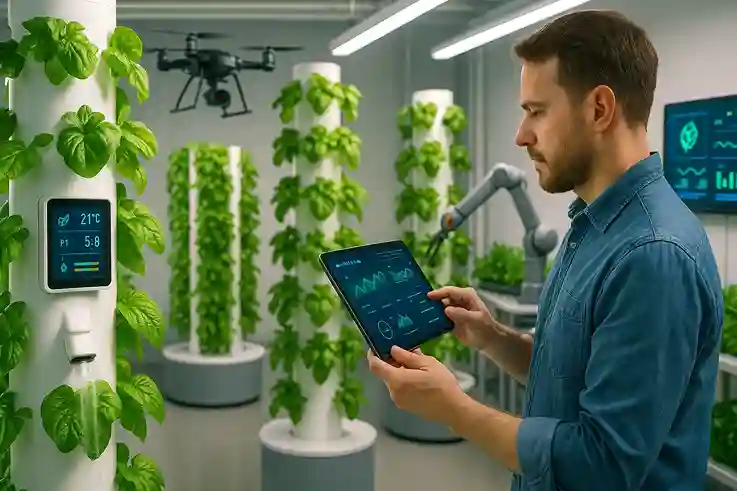
Artificial intelligence and the Internet of Things (IoT) are transforming how aeroponic systems operate. Tiny sensors placed throughout each tower monitor temperature, humidity, nutrient balance, and light exposure. AI algorithms then analyze this constant stream of data to predict and adjust conditions in real time.
For example, if sensors detect lower calcium absorption, the AI can instantly tweak nutrient ratios or misting frequency. It can even identify subtle signs of plant stress before they become visible. Through predictive analytics, the system learns seasonal patterns, crop preferences, and local weather shifts, ensuring that each plant receives exactly what it needs—no more, no less.
IoT networks connect multiple towers together, allowing farmers to oversee large-scale operations remotely. From a smartphone or dashboard, a grower can view data, trigger maintenance cycles, or run automated harvest schedules with a single tap.
Self-Regulating Nutrient Cycles
The future aeroponic tower will function like a self-sustaining biological computer. Using AI-driven feedback loops, each system will maintain nutrient cycles autonomously. Nutrient reservoirs will analyze depletion rates and automatically replenish precise mineral mixes, maintaining ideal pH and conductivity levels around the clock.
Advanced towers will also integrate water-purification membranes that recycle and sterilize the misting solution, further reducing resource waste. Solar panels and micro wind turbines may supply clean energy, making the entire unit energy independent. This shift from manual control to fully automated regulation represents the next major milestone in sustainable farming.
Autonomous Drones and Visual Intelligence
Beyond the tower itself, automation extends into the air. Autonomous drones equipped with multispectral cameras will scan plants for signs of disease, nutrient deficiency, or irregular growth patterns. These drones will communicate directly with the AI system, recommending corrections or adjustments instantly.
In large vertical farms, drones will even handle pollination, pruning, and precision spraying. By combining machine vision with aeroponics, future farms will maintain perfect crop health with almost no human intervention.
The future of the aeroponic tower merges data, energy, and biology into a seamless cycle of continuous optimization. Farmers will spend less time guessing and more time managing performance, guided by technology that learns and adapts. These innovations are shaping tomorrow’s food systems.
For readers interested in verified research and real-world data on aeroponic farming advancements across the U.S., explore the official resources and studies linked here to learn more.
(FAQs) About Aeroponic Tower
Conclusion: The Future Grows Upward with Aeroponic Towers
The aeroponic tower represents more than just a technological breakthrough—it symbolizes a turning point in modern agriculture. By lifting plants above the soil, it redefines how we think about growth, sustainability, and food security. Farmers can now produce more crops using less land, less water, and fewer resources, all while protecting the environment.
Across cities and rural landscapes, these vertical systems prove that farming doesn’t need to rely on tradition alone. From urban rooftops to solar-powered country fields, aeroponics offers a practical, scalable way to feed growing populations without exhausting the planet. Each tower becomes a symbol of resilience—a living structure that fuses nature with innovation.
With AI-driven precision, renewable energy integration, and near-zero waste, the aeroponic tower delivers a model for farming that’s smart, sustainable, and accessible. It stands at the intersection of science and soil-free simplicity, showing that the future of agriculture doesn’t lie beneath our feet but above them—growing toward the sky.
Technology and nature have finally found common ground—only now, that ground floats in the air.
Would you try aeroponic farming in your home or community? Share your thoughts, ideas, or experiences in the comments below—let’s grow the conversation together!

Michael Reyes is a versatile blogger with a primary focus on farming and sustainable living. Growing up close to nature, he developed a deep interest in agriculture and enjoys sharing practical tips on backyard farming, modern cultivation techniques, and eco-friendly practices. While farming remains his specialty, Michael also writes on a wide range of topics, from lifestyle and travel to everyday inspiration, making his work relatable to a broad audience.
Outside of writing, Michael enjoys spending time outdoors, experimenting with new farming methods, and exploring different cultures through food and travel. His approachable voice and well-researched insights make his blogs both informative and engaging.