If you’ve ever asked yourself what is 5G UC, you’re not alone. Many people notice the small “5G UC” icon flash on their phone screens but have no idea what it truly means. At first glance, it feels like just another tech acronym, yet behind those two letters lies a major shift in how the world connects.
5G UC stands for 5G Ultra Capacity, and it represents the powerful, faster tier of the 5G network. Unlike the standard 5G you might experience in wider rural areas, Ultra Capacity uses advanced mid-band and high-band frequencies to deliver dramatically higher speeds and lower latency. That means smoother streaming, faster downloads, and more reliable connections, even in crowded city centers.
This isn’t just about faster internet — it’s about enabling innovation across industries. From self-driving vehicles and smart cities to healthcare devices that respond in real time, 5G UC opens the door to an entirely new digital era.
In this article, we’ll break down what makes 5G UC different, explore the technology behind it, and uncover why it’s the foundation for the next generation of American connectivity and innovation.
What Is 5G UC and Why Does It Matter?
At its core, 5G UC, or 5G Ultra Capacity, is an upgraded form of 5G that delivers faster speeds and stronger performance. In simple terms, it uses a blend of mid-band and high-band frequencies to move data far more efficiently than the standard 5G network. This combination allows for a powerful balance between coverage and speed, making it the backbone of next-generation connectivity across the United States.
To understand where 5G UC fits in, it helps to look at how it relates to other 5G types. 5G Nationwide, the most common version, operates mainly on low-band frequencies. It offers broad coverage but delivers speeds similar to or slightly faster than 4G LTE. On the other end is 5G mmWave, which uses ultra-high frequencies to deliver lightning-fast speeds, though only within short ranges. 5G UC sits comfortably in the middle — it reaches further than mmWave while remaining much faster than Nationwide 5G.
U.S. carriers such as T-Mobile and Verizon use the “UC” label to show when devices are connected to this enhanced network tier. When that small “5G UC” icon lights up, users can expect faster downloads, smoother video calls, and more reliable connectivity.
Beyond convenience, 5G UC matters because it fuels innovation — powering smart cities, advanced healthcare, autonomous vehicles, and the ever-expanding Internet of Things (IoT). In short, it’s the bridge between everyday mobile use and America’s digital future.
“5G UC isn’t just a faster connection — it’s the spark that powers the next wave of human innovation.”
The Technology Behind 5G UC
Understanding the technology that powers today’s mobile world begins with a simple question: what is 5G UC really made of? Beneath that small symbol on your phone sits a sophisticated network that blends mid-band and high-band frequencies to create the backbone of ultra-fast, low-latency communication across the United States.
How Mid-Band and High-Band Frequencies Work Together
The secret behind what is 5G UC lies in its unique combination of mid-band (C-band) and high-band (mmWave) frequencies. The mid-band serves as the balanced layer — offering both strong coverage and excellent speed. It travels farther than high-band signals, making it ideal for suburban and urban areas. The high-band, also known as mmWave, handles short-range, high-capacity traffic. It enables lightning-fast data transfer, perfect for dense environments like airports, stadiums, or downtown centers.
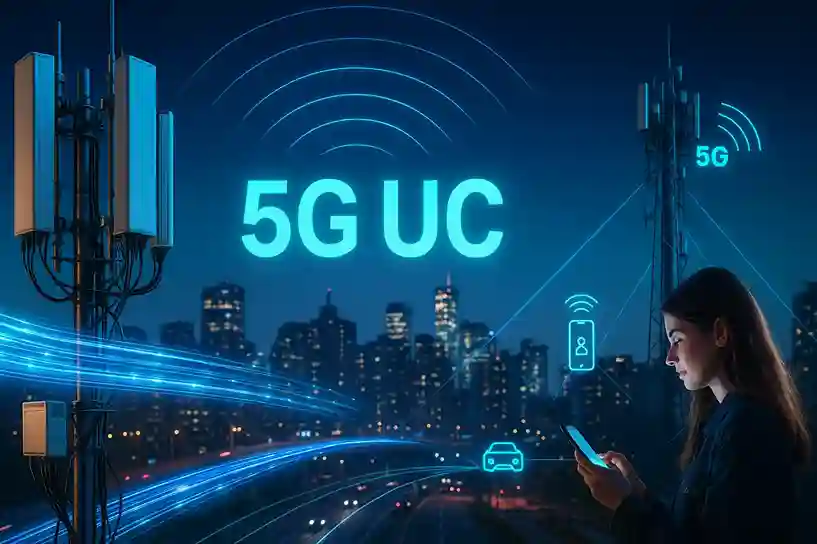
Together, these two layers create a synergized system. Your phone automatically connects to the best available band, ensuring that the network is both fast and stable. This dynamic collaboration is what makes 5G UC so much more powerful than traditional 5G Nationwide coverage.
A Highway Analogy: How Data Travels in 5G UC
To visualize what is 5G UC, think of it as a massive, multi-lane highway system for digital information. The low-band 5G acts like long rural roads — it stretches far but moves data slower. The mid-band, central to 5G UC, is like a major city freeway — wide, smooth, and built for steady, high-speed travel. Then comes mmWave, the express lane — ultra-fast but limited to certain zones.
When combined, these “lanes” allow your data to move swiftly and efficiently, no matter where you are. That’s why streaming a 4K video, joining a live meeting, or playing a cloud-based game feels smoother when your phone shows the 5G UC icon.
Speed, Latency, and Device Compatibility
Networks marked with 5G UC deliver speeds up to 10 times faster than 4G LTE. Latency drops dramatically, allowing near-instant responses — vital for online gaming, remote work, and smart devices. Additionally, most modern smartphones released in the U.S. since 2021 already support 5G UC, meaning you’re ready to experience its benefits right out of the box.
In short, understanding what is 5G UC reveals more than a simple network label — it’s the engine driving America’s digital transformation, ensuring every connection is faster, stronger, and smarter.
5G UC vs. 5G Nationwide: Understanding the Difference
If you’ve ever wondered what is 5G UC and why your phone switches between “5G” and “5G UC,” the answer is simple. Both are part of the same network but run on different frequency bands. This affects speed, coverage, and performance.
Speed and Performance
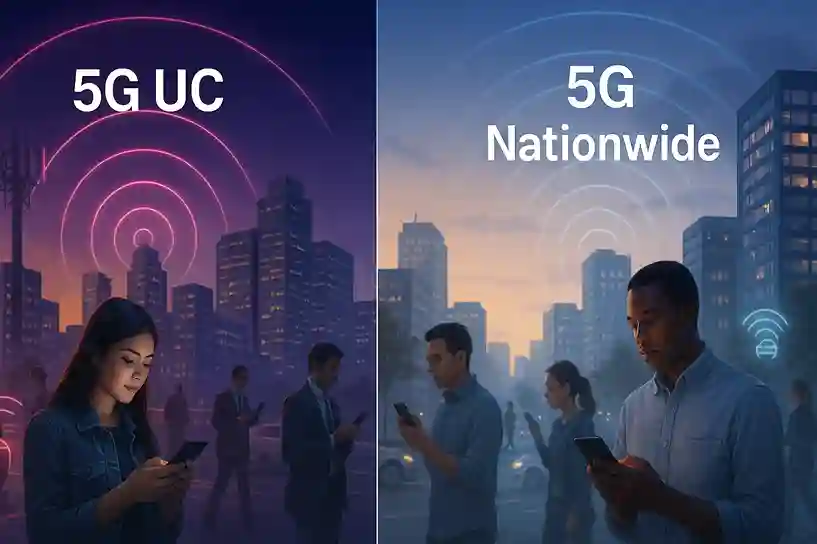
5G UC (Ultra Capacity) is the faster tier of 5G. It combines mid-band and high-band frequencies to deliver blazing speeds — up to 10 times faster than 4G LTE. This speed supports heavy data use like 4K streaming, cloud gaming, and real-time video calls.
5G Nationwide, however, relies on low-band frequencies. It covers long distances but delivers moderate speeds. Performance stays consistent across wide areas, though it may feel closer to 4G LTE.
Coverage and Connectivity
Your phone switches between 5G UC and 5G Nationwide depending on where you are. 5G UC works best in cities, airports, and business hubs. These areas have the infrastructure needed for faster signals.
5G Nationwide fills the gaps. It covers highways, suburbs, and rural zones where mid-band and mmWave aren’t fully deployed. Your device switches automatically between the two to keep you connected. When UC signals are strong, your phone locks onto them. When they’re weak, it shifts back to Nationwide mode.
5G UC vs. 5G Nationwide
| Feature | 5G UC | 5G Nationwide |
|---|---|---|
| Frequency Band | Mid/High | Low |
| Speed | Up to 10× faster | Moderate |
| Coverage | Moderate | Wide |
| Use Case | Cities, hubs | Rural areas |
Understanding what is 5G UC shows how it complements 5G Nationwide. Together, they form a balanced network built to keep America connected — from busy downtowns to remote open roads.
Everyday Benefits: How 5G UC Shapes Modern Life
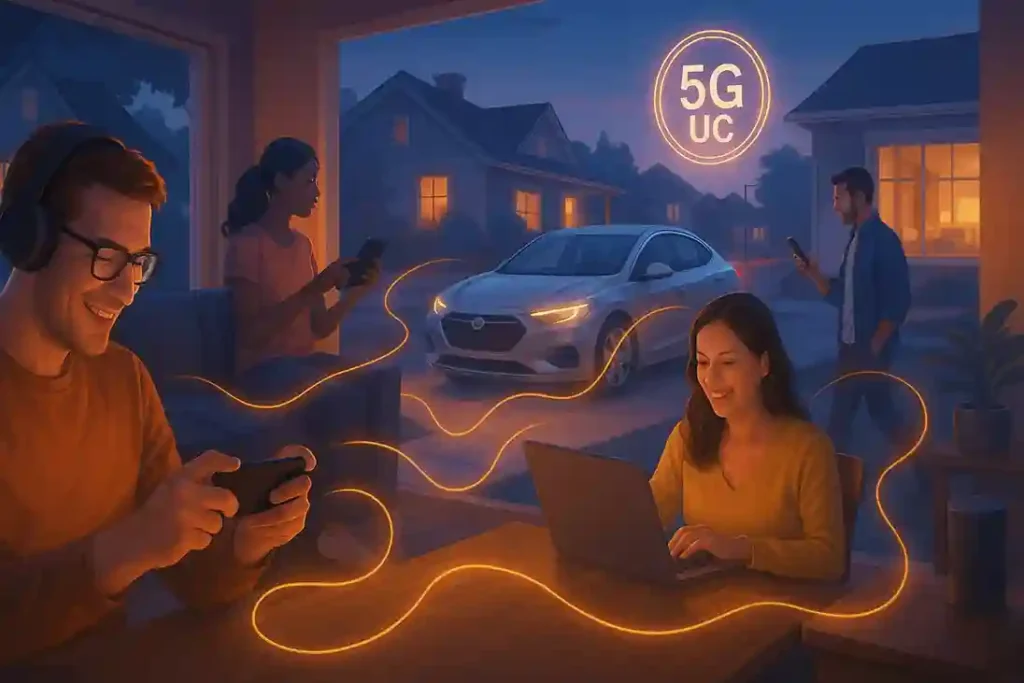
When people ask what is 5G UC, they often imagine futuristic technology that feels distant. In reality, it’s already changing daily life across the U.S. Every time you stream a show, join a video meeting, or play an online game without lag, 5G UC may be behind that seamless experience.
Entertainment Without Limits
5G UC brings a noticeable difference to entertainment. Streaming platforms load instantly, even in crowded areas. You can watch 4K videos or live sports without buffering. Gamers enjoy smoother cloud gameplay with almost no lag, thanks to the low latency that 5G UC provides. It’s like turning every mobile device into a portable, high-speed media center.
Video calls also benefit. Whether connecting with family across states or joining a work meeting, calls stay crisp and stable. The faster uplink and downlink speeds reduce dropped connections and frozen screens, even when networks are busy.
Smarter Work and Business Connectivity
For businesses, 5G UC has become a game-changer. Remote workers experience faster uploads, cloud access, and file sharing, enabling smoother collaboration from anywhere. Companies in logistics use 5G UC to power AI-driven tracking systems, allowing trucks, drones, and sensors to communicate in real time.
In healthcare, smart medical devices rely on these stable, low-latency connections for continuous monitoring. From remote surgeries to wearable health trackers, 5G UC ensures that critical data moves instantly and securely.
The U.S. Experience: Faster and Broader Every Year
Across the United States, 5G UC adoption is accelerating. Cities like New York, Dallas, and San Francisco already show massive speed gains, with average download rates several times faster than standard 5G. Carriers continue expanding mid-band coverage, allowing more Americans to access these higher speeds without relying on Wi-Fi.
Consumers are starting to notice the difference. Tasks that once required wired connections — video editing, cloud backups, large downloads — now run effortlessly over mobile data. Simply put, what is 5G UC is no longer a question of the future. It’s the driving force behind how America works, plays, and connects today.
The Ripple Effect: Industries Transformed by 5G UC
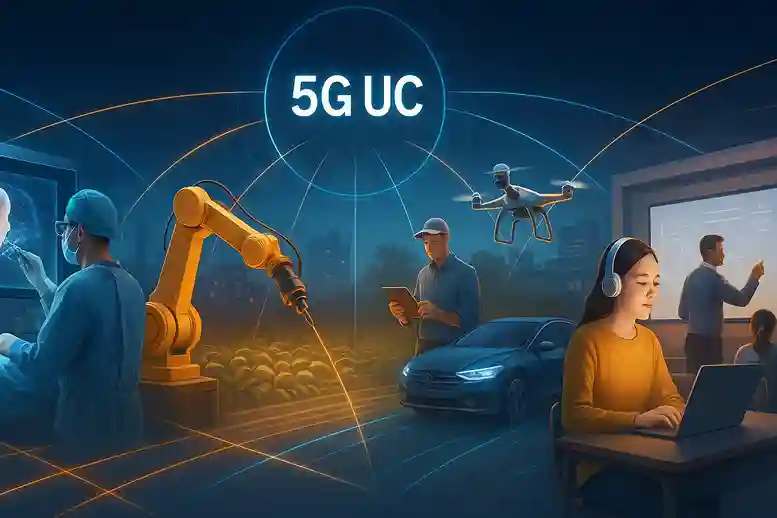
The power of what is 5G UC goes far beyond faster downloads and smoother streaming. Its true impact lies in how it’s reshaping entire industries across the United States. From hospitals to highways, from factory floors to film studios, 5G UC is fueling an era of connected innovation unlike anything before.
Healthcare: Real-Time Precision and Remote Care
Meanwhile, in healthcare, 5G UC is redefining what’s possible in patient care. With near-zero latency and ultra-reliable speeds, doctors can now perform remote surgeries using robotic systems guided by real-time data. High-resolution imaging, telemedicine consultations, and wearable devices all depend on the stability that 5G UC provides.
Imagine a rural hospital linked to a major medical center hundreds of miles away — surgeons viewing 3D scans instantly, specialists monitoring patients in real time, and AI-assisted diagnostics updating on the spot. That’s the promise of 5G UC in healthcare: equal access, faster response, and smarter treatment.
Automotive: The Road to Smarter Mobility
On American highways, 5G UC is becoming the backbone of the connected vehicle revolution. Cars are evolving into intelligent systems that communicate with each other, traffic lights, and road sensors. This vehicle-to-everything (V2X) communication helps prevent accidents, optimize traffic flow, and enhance navigation accuracy.
Picture autonomous vehicles reacting to changing road conditions in milliseconds. That instant exchange of information — powered by 5G UC’s low latency — is transforming mobility into a safer, more efficient experience for drivers and cities alike.
Manufacturing: Precision and Predictive Power
Inside U.S. factories, 5G UC drives automation and efficiency. Machines equipped with sensors and AI software communicate continuously through ultra-fast, stable networks. That allows for predictive maintenance, spotting equipment failures before they happen. Assembly lines run smoother, production waste decreases, and energy use becomes more efficient.
Manufacturers are embracing 5G UC to support smart robots, real-time quality control, and digital twins — virtual replicas of machines used to simulate performance and prevent downtime.
Entertainment: Immersive and Interactive Experiences
Meanwhile, in entertainment, 5G UC is reshaping how audiences experience content. With blazing-fast data transfer and minimal lag, creators can stream augmented reality (AR) and virtual reality (VR) experiences to millions in real time. Concerts, sports, and live shows can now include interactive elements, letting fans join virtually as if they’re right there.
From filmmakers streaming raw footage in 8K to gamers exploring fully immersive worlds, 5G UC turns creativity into connection — bridging imagination and technology with remarkable speed.
Across every sector, the ripple effect of what is 5G UC continues to expand. It’s not just changing industries; it’s creating a new foundation for innovation, productivity, and opportunity in the connected future of America.
Challenges and Myths About 5G UC
For all its promise, understanding what is 5G UC also means recognizing the challenges and misconceptions that come with it. While 5G Ultra Capacity is transforming how Americans connect, its rollout and real-world performance still face several hurdles.
Myth: 5G UC Is Always 10x Faster
Many believe that 5G UC guarantees lightning-fast speeds everywhere, but that’s not always true. The “up to 10x faster” claim represents ideal conditions — strong mid-band or high-band signals with minimal interference. In practice, speed varies based on your location, network congestion, and even the type of smartphone you use.
For instance, users in dense city centers often experience the fastest results, while those on the outskirts may see more modest gains. 5G UC still offers significant improvements over 4G LTE, but it’s not an instant miracle in every area.
Infrastructure and Rollout Limitations
Deploying 5G UC across the U.S. is a massive infrastructure challenge. Building and maintaining the mid-band and mmWave network requires thousands of new antennas, fiber connections, and upgraded towers. Urban regions have adopted it quickly, but rural areas lag due to cost, distance, and limited population density.
Some cities also face delays caused by local zoning laws and permit restrictions that slow the installation of new 5G equipment. These logistical barriers can postpone access, especially in smaller communities that rely on older infrastructure.
Device Compatibility and Spectrum Sharing
Another obstacle involves device readiness. While most new smartphones in the U.S. now support 5G UC, many older models do not. Consumers often assume their phones can use Ultra Capacity networks, only to discover their devices are limited to basic 5G or LTE.
Spectrum sharing adds another layer of complexity. Carriers must balance limited bandwidth between 4G LTE and 5G UC users. This shared spectrum can occasionally reduce performance in congested areas until more dedicated mid-band frequencies become available.
Local Regulations and Environmental Concerns
5G UC also faces scrutiny from local governments and residents. Some communities raise concerns about tower placement or signal interference, leading to extended review periods. Environmental factors — like building density, weather, and landscape — can also affect coverage consistency.
Despite these obstacles, the direction remains clear. Carriers continue to expand 5G UC coverage, improve hardware, and streamline regulations. While the path isn’t flawless, understanding what is 5G UC means recognizing both its incredible potential and the practical steps still needed to make it universal.
The Future: A Connected America
As the nation moves deeper into the digital era, what is 5G UC becomes more than just a question of speed — it’s a gateway to the connected future of the United States. 5G Ultra Capacity is already laying the groundwork for technologies that will shape the next decade, from 6G research to AI-driven automation. The next wave of innovation will depend on how effectively this infrastructure evolves and integrates with emerging systems.
Beyond 5G: The Road to 6G
While 5G UC is still expanding, researchers are already looking toward 6G, which promises speeds up to 100 times faster and even lower latency. American universities and telecom companies have begun exploring this frontier through government-supported programs. These efforts aim to strengthen U.S. leadership in global communications while ensuring secure, high-speed networks for both civilian and industrial use.
6G will likely depend on the foundation 5G UC is building today — advanced antenna systems, expanded mid-band spectrum, and efficient energy use. In short, 5G UC is the bridge to the next generation of hyper-connected technology.
Edge Computing and IoT Expansion
Meanwhile, edge computing and the Internet of Things (IoT) are rapidly evolving thanks to 5G UC. Edge computing brings data processing closer to where it’s generated — in homes, factories, or vehicles — cutting delays and boosting efficiency. When paired with 5G UC, it enables real-time analytics, powering smart sensors, autonomous machines, and predictive systems across industries.
The IoT ecosystem is growing fast in the U.S., with billions of connected devices managing everything from energy grids to home appliances. With 5G UC’s reliability and speed, these devices can now communicate instantly, creating seamless interaction between humans and technology.
Government Initiatives and Infrastructure Growth
The U.S. government has recognized 5G UC as a pillar of national innovation. Through initiatives like the National Telecommunications and Information Administration (NTIA) and the Infrastructure Investment and Jobs Act, funding is directed toward expanding high-speed broadband and 5G networks. These programs aim to improve access, especially in underserved communities, ensuring that every American benefits from the same level of connectivity.
Smarter Homes, Cities, and Industries
From smart homes that adjust energy use automatically to cities that manage traffic and public safety in real time, 5G UC will transform how America functions. Factories will run autonomously, healthcare systems will connect patients instantly, and transportation will synchronize across intelligent networks.
As technology continues to evolve, what is 5G UC becomes more than a definition — it becomes the foundation for a connected America. With each new antenna, innovation, and regulation, the nation moves closer to a future where speed, intelligence, and connection define everyday life.
(FAQ) On What is 5G UC?
Conclusion On What is 5G UC?
If you’ve ever wondered what is 5G UC, now you know it’s far more than a small symbol on your phone screen — it’s a breakthrough that’s redefining how America connects, communicates, and innovates. 5G Ultra Capacity combines the speed of high-band and the reach of mid-band frequencies to deliver a network that feels instant, powerful, and dependable.
Across the country, 5G UC is already fueling smarter cities, remote healthcare, connected vehicles, and new digital industries. It’s bridging the gap between imagination and reality — enabling experiences that once seemed futuristic. Whether you’re streaming high-definition content, managing a business from your phone, or relying on a smart device for health monitoring, 5G UC is working quietly in the background to keep everything seamless.
The path forward isn’t without challenges — expanding infrastructure, improving coverage, and ensuring access for all Americans will take time. Yet, with continuous innovation and national investment, the promise of 5G UC is already unfolding.
In the end, what is 5G UC can be summed up simply: it’s the technology that’s igniting a new age of innovation — connecting people, powering industries, and shaping the future of a truly connected America.
Share your thoughts in the comments below — your story could help others understand how 5G UC is transforming daily life across America.

Amina Pierce is a tech-savvy blogger with a specialty in electronics, where she shares practical insights on gadgets, innovations, and the latest trends shaping our digital world. With a strong interest in how technology impacts everyday life, she breaks down complex topics into clear, easy-to-understand articles for readers of all backgrounds. While electronics is her main focus, Amina also enjoys writing on a variety of other subjects, including lifestyle, travel, and personal growth, making her content both diverse and engaging.
Outside of blogging, Amina loves tinkering with new devices, exploring smart home solutions, and capturing her experiences through travel photography. Her blend of technical knowledge and approachable style makes her a trusted source of information and inspiration.