“5G UW” stands for Ultra-Wideband. It’s the fastest version of 5G available today. It uses high-frequency signals that move more data than regular 5G. As a result, it offers faster downloads, smoother streaming, and very low lag. Many carriers promote it as a premium network for people who want top performance.
However, the story isn’t that simple. The signal travels only short distances. It also weakens when it passes through walls or buildings. Because of that, even though 5G UW can reach gigabit speeds, coverage still feels uneven. In some areas, it performs well. In others, it quickly drops to regular 5G. This gap creates a clear difference between promises and real results. Yet, as networks grow and more towers appear, 5G UW keeps improving. Step by step, it moves closer to a future where mobile speed feels instant everywhere.
“5G UW isn’t just faster 5G — it’s a glimpse into the future of true ultra-speed connectivity, where every second counts.”
The Science Behind 5G UW Speeds
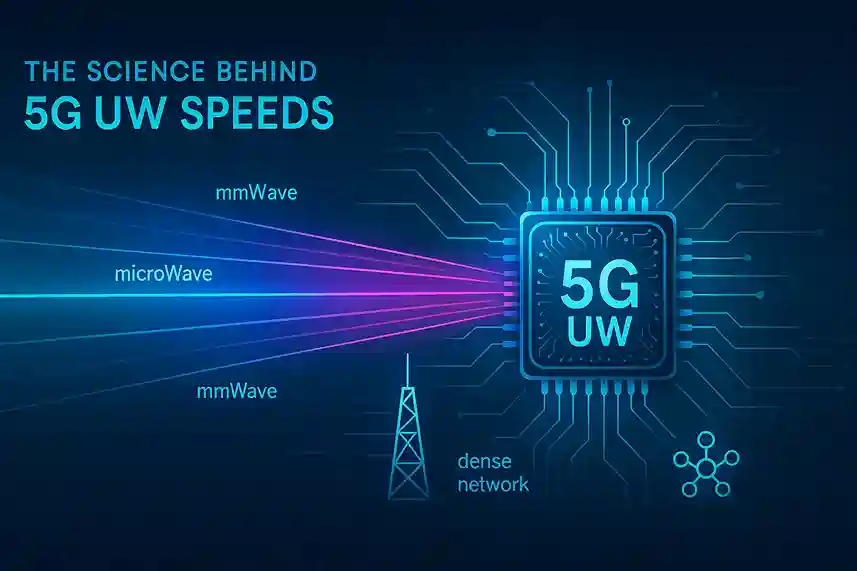
The power behind 5G UW lies in millimeter-wave, or mmWave, technology. These waves sit at the top of the 5G frequency spectrum, usually between 24 GHz and 40 GHz. They carry much more data than lower frequencies, which allows lightning-fast downloads and ultra-low latency. Because of this, mmWave supports the “Ultra-Wideband” name that sets 5G UW apart from standard 5G connections.
To understand how 5G UW works, it helps to compare the main frequency bands. Low-band 5G offers the widest coverage but the slowest speeds, often close to 4G LTE. Mid-band 5G provides a balance — decent speed with broader range. mmWave, however, focuses on extreme speed, reaching several gigabits per second. Yet, this speed comes with trade-offs. Since millimeter waves have short wavelengths, they struggle to travel far and can’t easily pass through obstacles like buildings, trees, or even rain.
In real-world use, 5G UW coverage depends heavily on the environment. Open areas, stadiums, airports, and city centers tend to perform well because they have clear lines of sight and dense cell networks. But in suburban or indoor spaces, signal loss often limits performance. Even small movements can change speed results dramatically.
Only certain devices can connect to 5G UW networks. Phones like the latest iPhone and flagship Android models include specialized antennas designed to detect and process mmWave signals. Without these, users connect only to lower 5G bands. As a result, device compatibility plays a key role in the real speed people experience every day.
Real Performance: Speed Tests vs. Reality
When it comes to 5G UW, the promise of ultra-fast speed sounds exciting. Carriers advertise gigabit-level performance and near-zero lag. However, field data often tells a different story. Real-world testing across U.S. cities reveals that while 5G UW can indeed reach incredible speeds, it doesn’t stay consistent everywhere.
Average Speeds in U.S. Cities
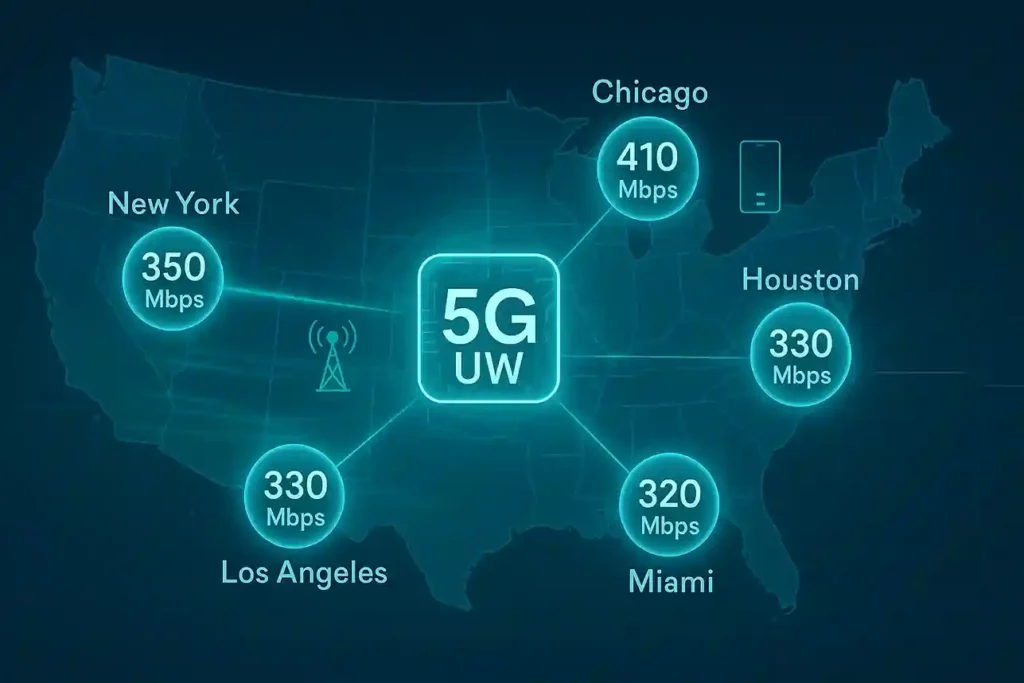
Independent field tests from cities like New York, Chicago, Los Angeles, and Miami show mixed results. In ideal outdoor conditions, 5G UW downloads can exceed 2.5 Gbps, with uploads averaging around 200–300 Mbps. However, these speeds appear only within a short radius of the 5G Ultra-Wideband tower — often less than 1,000 feet.
Once users move behind walls, trees, or vehicles, performance drops sharply. In urban downtowns, where towers are close together, speeds stay strong. But in suburban neighborhoods, signal interruptions and reduced line-of-sight can cut speeds to below 400 Mbps. Despite that, it still outperforms regular 5G and 4G LTE networks in most areas.
Lab Data vs. Real-World Results
Lab tests measure 5G UW under ideal conditions — perfect line-of-sight, minimal interference, and no user congestion. Those tests often record peak speeds of 4–5 Gbps. Yet, in daily use, network traffic, weather, and physical barriers interfere with mmWave signals. Consequently, the average user rarely reaches those lab numbers.
Hotspot devices show similar patterns. While they can deliver multi-gigabit connections in open outdoor spaces, indoor performance falls once signals face glass, brick, or concrete. Even reflections from nearby buildings can distort speed readings.
How Distance Affects 5G UW Performance
Distance from the cell tower remains the most critical factor. Within 300–500 feet, speeds stay close to the gigabit range. Beyond 1,000 feet, they often drop below 200 Mbps. This decline occurs because mmWave frequencies lose strength faster than lower-band signals. For example, walking from an open plaza to a nearby café can reduce speeds by 80%.
As a result, carriers deploy many small cells to maintain coverage in dense zones. These small cells create a web of short-range transmitters that help keep connections stable. However, building such networks takes time and significant investment, which explains why 5G UW is still limited to specific regions.
Theoretical vs. Actual Speeds
| Connection Type | Theoretical Download Speed | Average Real-World Speed |
|---|---|---|
| 5G UW (mmWave) | Up to 5 Gbps | 1–2.5 Gbps |
| 5G Mid-Band | Up to 1.5 Gbps | 300–800 Mbps |
| 4G LTE | Up to 150 Mbps | 30–70 Mbps |
In short, 5G UW delivers unmatched speed under the right conditions. Still, its real-world performance depends on location, line-of-sight, and distance. As coverage expands, users will see these numbers climb closer to what the technology truly promises.
Coverage Challenges and Network Limitations
The promise of 5G UW lies in its incredible speed, yet its limitations often go unnoticed. Ultra-Wideband depends on millimeter-wave (mmWave) signals, which can carry huge amounts of data but travel only short distances. These limits shape how networks are built and how users experience coverage in the real world.
The Short Range of mmWave Signals
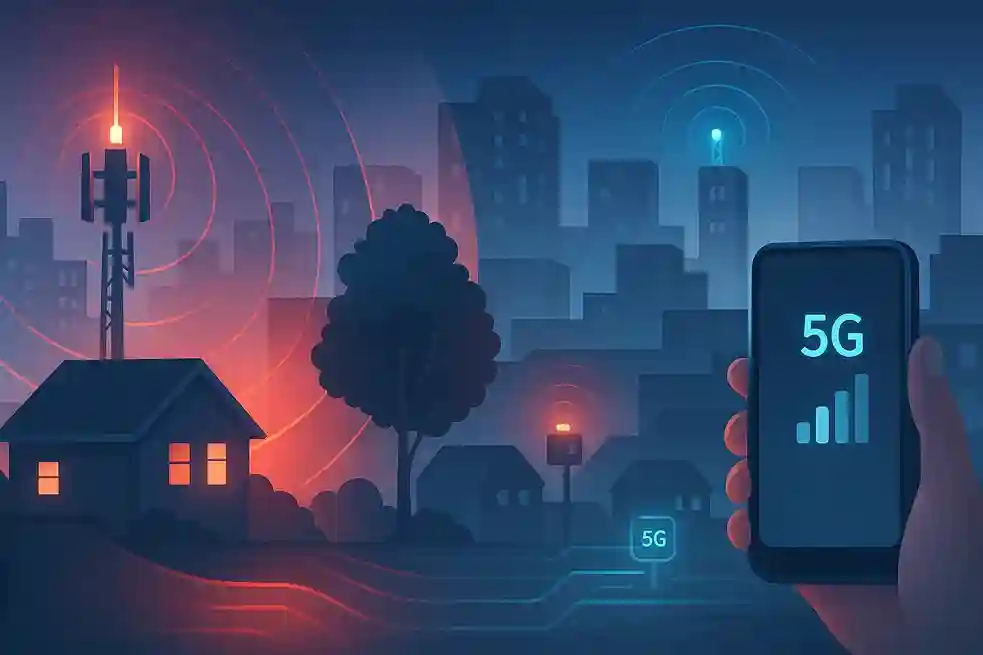
The mmWave frequencies used by 5G UW typically range between 24 GHz and 40 GHz. While these frequencies allow massive data capacity, they also have very short wavelengths. Because of that, the signal weakens quickly as it travels away from the cell tower. Unlike lower-band 5G or 4G signals, mmWave cannot bend around corners or pass through most materials. In open outdoor areas, users can enjoy speeds over 2 Gbps. Yet, once they move even a few hundred feet away, the signal can fade dramatically.
Why Dense Small-Cell Networks Are Essential
To solve this range problem, providers rely on small-cell deployment. Small cells are compact, low-power base stations placed on lamp posts, rooftops, and utility poles. Each small cell covers only a small area — often less than 1,000 feet. Therefore, networks need thousands of these mini-towers to provide reliable 5G UW service across a city.
In crowded places like downtown districts, stadiums, airports, and shopping centers, this setup works well. Users enjoy stable, high-speed connections because many small cells overlap. However, in suburban or rural zones, installing this dense infrastructure becomes expensive and difficult. That’s why many areas still lack consistent 5G UW coverage today.
Environmental Barriers That Block Signal Strength
Even within strong coverage zones, physical barriers cause major issues. Walls, glass, trees, and even rainfall can block or reflect mmWave signals. For example, a user who steps from an open street into a building may instantly see their signal drop from 2 Gbps to under 200 Mbps. These interruptions create frustration and highlight how sensitive 5G UW is to surroundings.
Switching Between 5G UW and Regular 5G
When users move, their phones often switch between 5G UW and mid-band 5G. This helps keep connections stable. Still, the switch can cause speed changes. Regular mid-band 5G travels farther but runs slower, usually under 1 Gbps.
Expanding Coverage with Hybrid Networks
Carriers now build hybrid networks that mix low, mid, and mmWave bands. The low band covers large areas. The mid band balances range and speed. The mmWave layer adds extreme performance in select spots.
To improve reliability, providers use beamforming and carrier aggregation. These help direct signals and combine frequencies for stronger links. AI systems now manage these handoffs automatically. Step by step, this technology makes 5G UW more stable and accessible. Eventually, users will enjoy ultra-fast connections almost everywhere.
Devices That Support 5G UW
Not every 5G phone can handle 5G UW. Only specific models include the advanced antennas and hardware needed to connect to Ultra-Wideband signals. These phones can access the high-frequency mmWave bands that make 5G UW so fast.
Popular Smartphones with 5G UW Compatibility
Most top-tier smartphones today support 5G UW. These include:
- Apple iPhone 12, 13, 14, and 15 series (U.S. models)
- Samsung Galaxy S21, S22, S23, and S24 series
- Google Pixel 6, 7, and 8 series
- Motorola Edge+ and Razr 40 Ultra
- OnePlus 11 and OnePlus 12
These devices come equipped with mmWave antennas designed to detect and use Ultra-Wideband frequencies. However, not all models sold globally have the same hardware. Many phones released outside the U.S. skip mmWave antennas to cut costs, limiting them to mid-band or low-band 5G.
Why Not All 5G Phones Handle UW Signals
Some 5G phones lack the internal components needed for mmWave. These components are expensive and take up space inside the phone. Since mmWave signals require special antenna modules placed around the device’s frame, adding them can make phones slightly thicker or costlier.
Budget and mid-range models often focus on Sub-6 GHz 5G instead, which provides wider coverage but slower speeds. This approach helps keep prices low while still offering basic 5G access.
Antenna Design, Battery, and Heat
Phones that support 5G UW use several antennas around the frame. This helps capture high-frequency signals even when you move the phone. Still, these antennas use more power, which can drain the battery faster.
To balance power, newer processors switch between 5G UW and regular 5G based on signal strength. This saves energy without cutting performance. However, fast data transfer also creates extra heat. To manage that, manufacturers use cooling layers and smart thermal systems that reduce overheating.
Check Compatibility Before Upgrading
Always check your carrier’s specifications before buying. Each provider uses different labels such as 5G UW, 5G+, or 5G mmWave. Make sure the phone you choose supports those frequencies in your area.
A compatible phone unlocks the real potential of 5G UW. It not only delivers faster speeds today but also keeps you ready for future network upgrades.
How 5G UW Impacts Everyday Use
The arrival of 5G UW changes how people stream, play, and work online. Its ultra-fast speed and low latency create a smoother, more responsive experience across nearly every digital activity. Whether you’re watching high-resolution videos, joining live meetings, or controlling smart devices, 5G UW makes each action feel almost instant.
Faster Streaming and Seamless Entertainment
With 5G UW, video streaming runs far more efficiently. Users can watch 4K or even 8K content with no buffering. Apps load faster, and switching between videos happens in seconds. Live events — from concerts to sports — stream in near real time, keeping delays almost invisible. This level of performance gives mobile users the same experience once possible only on fiber networks.
Smoother Gaming and Virtual Experiences
Gaming benefits the most from 5G UW’s low latency. Actions on the screen respond almost instantly to player input. Online multiplayer games become more stable, even during peak hours. Cloud gaming services, which stream games instead of downloading them, now run smoothly on mobile networks.
The technology also strengthens AR and VR experiences. Augmented reality apps overlay data on real-world images with perfect timing, while virtual reality headsets sync smoothly with the cloud. Because of this, creators can design richer and more immersive environments without worrying about lag.
Faster Work and Cloud Performance
5G UW helps professionals stay connected anywhere. Video calls and file uploads stay smooth even in crowded places. Cloud apps react fast, allowing real-time edits and teamwork. Workers in design, education, and media can share large files without long waits.
Benefits for Healthcare and Logistics
5G UW also helps major industries. In healthcare, doctors can guide robotic surgeries from miles away with almost no delay. Hospitals can send patient data quickly and securely between systems. In logistics, real-time tracking keeps fleets efficient. Automated robots in warehouses use stable, low-latency signals to move goods safely.
A More Connected Future
Overall, 5G UW brings faster, smarter, and more reliable connections to daily life. From gaming to healthcare, it links people and devices in real time. As networks grow, more users will feel the full impact of 5G UW — speed that makes every moment count.
Future of 5G UW and What Comes Next
The future of 5G UW looks faster, smarter, and more connected than ever. As carriers continue expanding coverage, researchers already prepare for what comes next — the early steps toward 6G. These upgrades will not only boost speed but also make networks more efficient and adaptable.
Upgrades That Strengthen 5G Ultra-Wideband
The next wave of 5G UW will aim to expand range and cut energy use. Engineers are creating new antenna designs to help mmWave signals travel farther with less loss. Updated chips will handle data more efficiently and let phones switch between frequency bands faster. Together, these upgrades will make 5G Ultra-Wideband more stable, efficient, and reliable — even in crowded cities or distant rural areas.
Early Research Toward 6G
Researchers are now exploring 6G, the next generation of wireless technology. Early studies suggest speeds up to 100 times faster than 5G and almost zero delay. 6G will likely use terahertz frequencies, which can move massive amounts of data for complex tasks like holographic calls and AI-driven systems. For now, 5G UW serves as a bridge — a testing stage for new technologies that will shape how 6G works.
Satellite-Backed and Hybrid Coverage Plans
Carriers are also turning to satellite-backed 5G to fix coverage gaps. These networks use both satellites and ground towers to keep users connected in remote areas. A hybrid network will allow phones to move between satellites, small cells, and mid-band towers without losing signal. This approach could bring 5G UW to highways, rural towns, and even ships at sea.
AI Optimization for Smarter Networks
Artificial intelligence will play a major role in optimizing 5G UW. AI can monitor network activity, reroute traffic, and prevent signal drops. It will also predict issues before they affect users. As a result, connections will become faster, more stable, and more energy-efficient.
A Bridge Toward the 6G Era
5G UW stands as a critical step toward 6G. It proves that high-frequency networks can power smart cities, self-driving cars, and global real-time communication. Full 6G is still a few years away, but each improvement to 5G UW brings it closer. The future will be one where connection feels instant, intelligent, and limitless.
Frequently Asked Questions About 5G UW
Have you tried Ultra-Wideband yet? Share your experience below — whether it amazed you or left you waiting for better coverage.
Your feedback helps others understand how this new network performs in real life.

Amina Pierce is a tech-savvy blogger with a specialty in electronics, where she shares practical insights on gadgets, innovations, and the latest trends shaping our digital world. With a strong interest in how technology impacts everyday life, she breaks down complex topics into clear, easy-to-understand articles for readers of all backgrounds. While electronics is her main focus, Amina also enjoys writing on a variety of other subjects, including lifestyle, travel, and personal growth, making her content both diverse and engaging.
Outside of blogging, Amina loves tinkering with new devices, exploring smart home solutions, and capturing her experiences through travel photography. Her blend of technical knowledge and approachable style makes her a trusted source of information and inspiration.